
微博
中超联赛部分恢复主客场赛制_我的网站

A |
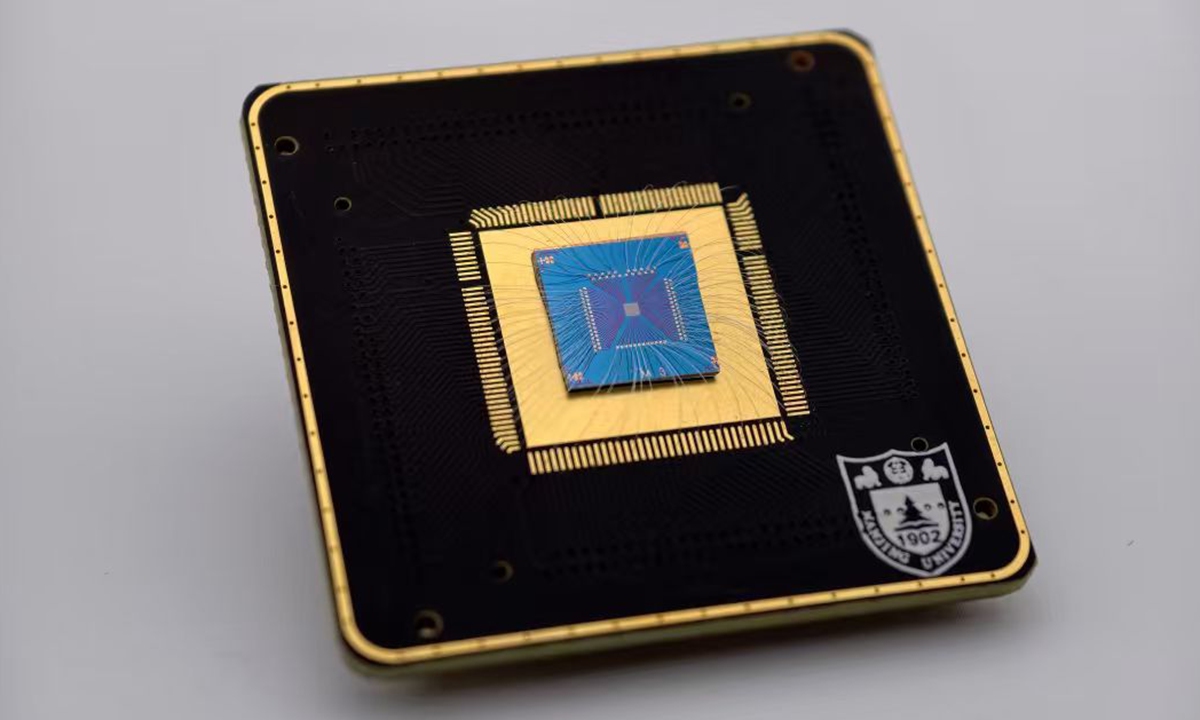
A Chinese research team from Nanjing University has developed a new ultra-low-power intelligent vision sensor chip, dubbed "LightTok," that can convert light signals into tokens within the sensor, significantly reducing the high energy consumption caused by frequent transfers of massive amounts of redundant data, the principal investigator told the Global Times.
According to a release from the Institute of Brain-Inspired Intelligence of Nanjing University, tokens generated by the LightTok chip can be directly fed into a Transformer encoder for image recognition.
"Our design idea was to move token generation onto the sensor itself, allowing the chip to directly produce tokens that AI models can process once light reaches the sensor," Miao Feng, director of the Institute of Brain-Inspired Intelligence at Nanjing University, told the Global Times on Thursday. "These tokens contain complete image information."
Physical AI refers to intelligent systems capable of autonomously perceiving, reasoning, acting and receiving feedback in the real world, representing a key pathway for AI to move from the digital realm into the physical world. Vision-based physical AI systems powered by large AI models need to convert visual information from real-world environments into tokens that can be processed by AI models before feeding these tokens into Transformers for subsequent tasks.
In traditional visual perception pipelines, light signals must go through multiple stages, including image sensing, analog-to-digital conversion, data buffering and transfer, digital image patching and embedding, before being transformed into tokens that AI models can process. The frequent transfer of massive amounts of redundant data has resulted in high energy consumption at the edge, according to a report by Science and Technology Daily.
The LightTok chip directly addresses a key challenge in physical AI hardware: how to efficiently acquire and tokenize visual information from the physical world with low energy consumption, Miao said.
The LightTok chip consists of a photosensitive memory array and peripheral circuits. The team built the array based on single-layer molybdenum disulfide (MoS₂) floating-gate phototransistors, with each pixel capable of sensing light, storing information and performing analog computing. By processing optical information directly within the chip, the device can convert captured visual signals into tokens for AI models, according to the research team.
The current LightTok prototype has a resolution of 32×32 pixels, or 1,024 photosensitive pixels, which is still smaller than that of smartphone cameras and industrial imaging systems. However, Miao said the technology is compatible with CMOS manufacturing processes and can be scaled up. With wafer-level growth of molybdenum disulfide materials, the chip could potentially achieve a scale comparable to existing imaging devices.
Miao said the chip also draws inspiration from the information-processing mechanism of human vision. Similar to how the retina extracts key visual information before transmitting it to the brain, the chip also aims to process visual information at an early stage.
The research was conducted in collaboration with another research team from the National University of Singapore. The findings were published on Wednesday in Nature Sensors, an internationally renowned journal in the field of sensing technology, according to the release.
Potential applications for LightTok include drone systems, autonomous remote sensing and small-scale embodied AI systems, Miao said. In these scenarios, devices need to continuously detect, understand and track targets, generating massive amounts of visual data. By reducing the energy required for visual processing, the technology could extend the operating time of drones, satellites and small robots with limited power supplies, the expert said.
。
新华社长春7月30日电(记者周万鹏)吉林东北虎篮球俱乐部30日宣布与多米尼克·琼斯完成续约,待向CBA联盟正式报送注册材料并经审核、公示通过后,琼斯将代表吉林男篮征战新赛季CBA联赛。这将是琼斯与吉林男篮牵手的第六个赛季。上赛季,琼斯为吉林队出战29场,场均贡献27分、9.8个篮板、9.3次助攻和2.4次抢断,并率队在季后赛首轮淘汰北京队跻身八强。
Current article:http://www.linlangdouwaqiexusan.bond/list_jz8b/wvrbnq.html
Published on:00:39:38
相关文章
- 1我国实现多领域高端钢材自主量产,我国实现多领域高端钢材自主量产
- 2《GTA6》泄露哥“大葱哥”Cyberleek被做进《给他爱5》:还能变身瞬移大战警察
- 3从环境卫生治理到全面社会健康管理——第36个爱国卫生月基层扫描
- 4多家美国人工智能公司下调大模型使用价格,美媒:中国大模型的开源和定价策略给美国公司带来压力
- 5扣非增长800%,在手订单超过48亿,这家半导体设备为何狂飙?| 1105 张博划重点
- 6AITO问界M5全新升级,新增离车落锁等200余个功能点
- 7锚定AI创新发展第一城核心承载地再出发 科创成果落地生“金”的余杭路径
- 8桐昆股份:上半年净利润42.22亿元 同比增长285.03%
- 9中央生态环境保护督察已实现三轮全覆盖督察
- 10【ワークマン】スマホよりも小さくて薄いミニ財布!本革っぽいから980円には見えない!お札は折らなくてOK
- 11【研报观点】8月26日沪镍最新观点汇总
- 12中国央行25日开展5000亿元MLF操作,中国央行25日开展5000亿元MLF操作
- 13周末大利好!1361亿项目集中签约!万亿算力赛道迎来重磅驱动
- 14中国第16次北冰洋考察|“雪龙2”号开展冰站作业
- 15Blockage of Russian Bond Payments to Erode Dollar Dominance, French Economist Says
推荐图文
 官方:加拿大中场内森·萨利巴加盟黄潜,据悉转会费1500万欧
 B站诉争哔哩哔哩商标被驳回
 遇见就有可能,定制你的专属幸运!
 China turns tennis tournaments into tourism magnet as cities package matches with culture, food and city experiences
 2026年全国早稻总产量565.8亿斤
 IT之家实况照片:华为Mate 20 Pro Fuleihong/亮星蓝图鉴赏
最热文章
- 1做实做细就业指导服务 当好学生生涯规划的“摆渡人”
- 2男子高空作业时在30楼遇马蜂窝,速降近百米躲避仍被蛰近30口
- 3刮刮乐五彩钻&耀出彩在重庆再上新!最高奖金100万元
- 4外交部副部长苗得雨会见伊朗外交部副部长加里布阿巴迪
- 5午间涨跌停股分析:48只涨停股、4只跌停股,金健米业7天5板,登海种业6天3板,万向德农涨停
- 6陆军第82集团军某特战旅组织数百名特战精英跨昼夜比武考核
- 7这场国家级数字出版博览会,为何值得奔赴?
- 8“它制作精良,但是……”——前 PlayStation 负责人曾警告《光与影:33号远征队》开发者,若将其称为“回合制 RPG”可能会被玩家忽视。
- 9警惕!这些照片,别随便晒!
- 10菲律宾智库专家:中菲关系紧张升级,背后主要有三大原因
- 11微软的新专利:表面拨号2或触摸支持
- 12新型轮式地空导弹射击演练
- 13国家统计局:2026年全国早稻播种面积4744.3千公顷,比2025年增加1.4千公顷
- 14开发商343i为肢体残缺儿童提供《光环》主题义肢
- 15抚顺市进一步完善残疾人社会保障制度和关爱服务体系