
爱奇艺
"My Father's Legacy Is Me Being The Best Version Of Myself": Babil Khan On Irrfan Khan – Exclusive_我的网站

A |
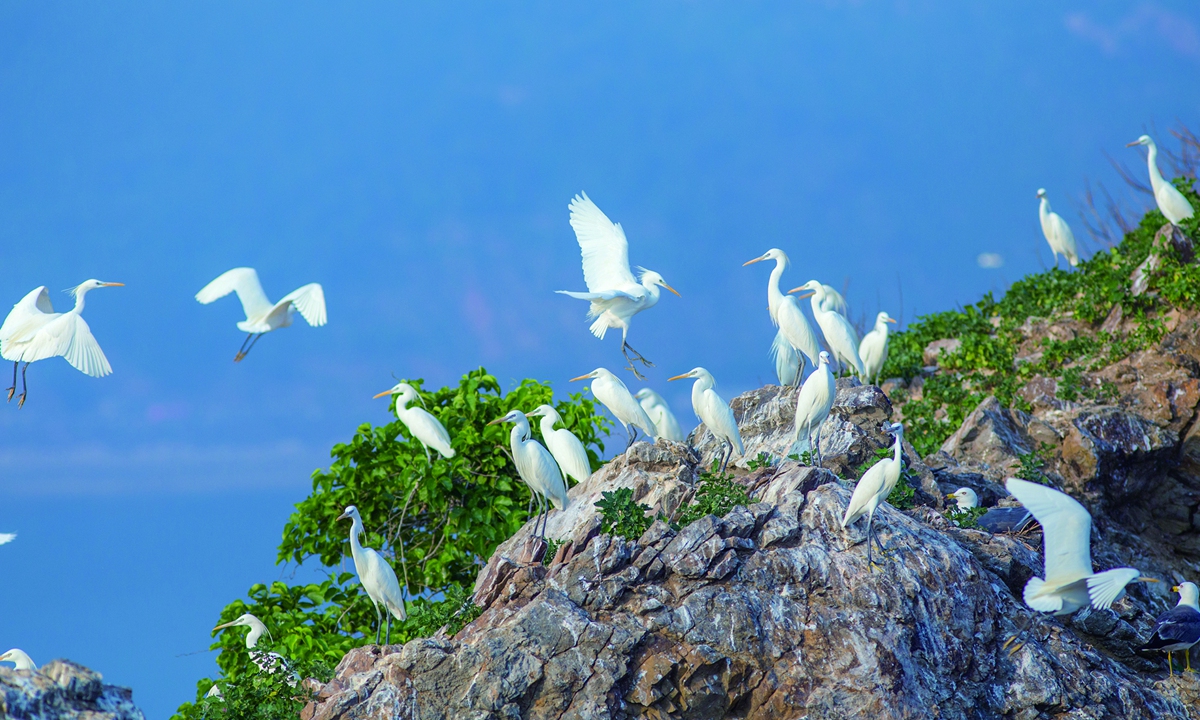
At 5 am, Wang Piyu, deputy director of the Changhai County Natural Resources Affairs Service Center, sets out by patrol boat for Fantuozi Island, a core breeding site for Chinese egrets in the Changshan Archipelago, Northeast China's Liaoning Province. The island has no permanent residents.
About 100 meters from the island, Wang turns off the engine and reminds accompanying researchers to keep their voices low to avoid disturbing the nesting birds.
Stepping onto the island, they walk along paths covered with vines. Scattered across the rocky slopes are nests measuring 40 to 50 centimeters in diameter. Inside, fluffy chicks huddle together among soft grass woven into nests, while adult birds perch high in the trees, watching cautiously.
"This was not what the island looked like 10 years ago," Wang recalled. "People used to collect eggs here, and coastal aquaculture polluted the tidal flats. Many parts of the island were bare, leaving little vegetation for birds to nest."
The recovery of Changshan Archipelago, however, has turned the remote archipelago into an important link in global conservation efforts.
At the 48th session of the UNESCO World Heritage Committee in Busan, South Korea, the boundary modification of the Migratory Bird Sanctuaries along the Coast of Yellow Sea-Bohai Gulf of China was approved, officially adding the Changshan Archipelago to the World Heritage site.
The expansion further strengthens the integrity of the serial natural heritage site, following a previous update in 2024, and highlights China's efforts to integrate coastal ecosystem conservation, according to the National Forestry and Grassland Administration.
Behind the World Heritage recognition lies years of conservation work involving local authorities and island residents.

Located in the northern Yellow Sea off Dalian, the Changshan Archipelago sits along a key route of the East Asian-Australasian Flyway, providing an essential stopover where tens of millions of migratory birds replenish their energy during their journeys across the Bohai Sea.
The newly added area covers more than 4,900 hectares and is home to more than 140 recorded bird species, including the Chinese egret and black-faced spoonbill, both listed as China's national first-class protected animals.
In 2015, more than 300 Chinese egrets arrived in Changhai county. After discovering the birds, local authorities introduced a series of protective measures, including establishing patrol teams and installing remote monitoring systems to reduce human disturbance.
However, the growing bird population also created new challenges.
Less than half of Fantuozi Island was covered by shrubs, which serve as the nesting grounds for the egrets. Additionally, the island's poor soil and acidification caused by years of accumulated bird droppings had led to the withering and death of some shrubs in recent years.
From 2022, the county launched an ecological restoration project, replacing surface soil with fertile earth and planting more than 2,200 shrubs.
The efforts helped restore the breeding habitat. The number of Chinese egrets on the island has since recovered, with this year's population estimated at about 3,500, including around 1,500 adults and nearly 2,000 chicks, according to Lü Yongquan, director of Changhai county's natural resources bureau.
"Chinese egrets are highly sensitive to water quality, vegetation and human disturbance. Their return to breed here is a sign that the marine ecosystem has recovered and is thriving," Lü told the Global Times.
From fishermen to guardians
Conservation in Changhai is not only carried out by authorities. Local communities have also gradually become part of the protection network.
Authorities have expanded public awareness campaigns and strengthened patrols. Because most of the Changshan Archipelago is uninhabited, drones, fixed-point infrared cameras, and on-site inspections are used to monitor the islands and reefs around the clock.
Many fishermen who once relied on the sea for their livelihoods now help protect it.
During the peak breeding season from April to July, regular marine patrols are carried out to protect nesting sites and prevent illegal egg collection and habitat damage. Local bird conservation groups and research institutions have also joined the efforts, while fishermen have taken on new roles as volunteer guardians of the islands.
Across Changhai county, many fishermen now actively participate in coastal patrols to help protect the archipelago's biodiversity.
For Li Qingsen, a 50-year-old island native and member of the county's forest fire brigade, protecting the birds has become a way of life.
From spring to autumn, 20 team members take turns staying on Fantuozi Island in pairs to protect the birds from disturbance.
Life on the 0.08-square-kilometer island is far from easy. There are no freshwater sources or docks. Patrol workers carry large barrels of water and wade ashore from boats anchored offshore. Instant noodles are often their main food because they require little preparation and some water.
Their work is closely tied to the seasonal cycle of the birds. Each April, thousands of Chinese egrets arrive in the archipelago from Southeast Asia to breed and rear their young, staying until early September before migrating south for the winter.
At present, young egrets are already practicing flight above the treetops. By autumn, they will join their parents in a southward migration.
For Wang, who has spent half of his life guarding Fantuozi Island, the World Heritage recognition is both a homecoming for the birds and a reward for years of protection. "Now, it is a home for the birds, and a reward for all the years we have spent protecting it."
。 Babil understands that he has his father, Irrfan Khan's, legacy to carry forward, but he looks at it quite positively. For him, maintaining the legacy is not about imitating his late father or copying his journey. It's about creating his identity. The legendary actor passed away on April 29, 2025. In an exclusive conversation with Filmfare, Babil told us that the legacy is all about being himself. "The legacy is about being myself. People think that because there's a legacy, I have to do things a certain way. My father's legacy would be me being the best version of myself and not try to imitate him and his journey. He had his journey. He was a father and he raised me along with my mother. I want to fight for my individuality. Fight is a bad word. I would love to have fun with my individuality. That's his legacy." But there will always be comparisons with Irrfan, and Babil knows that. However, he does not let something that he can't control bother him." View this post on Instagram A post shared by Babil (@babil.i.k) "Yes, people will compare. I can't control that. I don't have the time to let it affect me. If I do that, then I won't be able to finish reading scripts and go to all the meetings. I have a lot of things to do, like making music, reading a lot of books, and enjoying doing that. So I spend time doing that instead of scrolling. I don't spend time thinking about what somebody else is thinking of me. I did that initially, and that hurt a lot. This is not how I want to live my life, and I started finding ways to navigate that," concluded Babil. Babil Khan was last seen in the film Logout.See Also: Irrfan Khan’s son Babil Khan shares a picture of the late actor’s grave。
Current article:http://www.linlangdouwaqiexusan.bond/41o/4z9l0f.docx
Published on:21:43:26
说出你的故事_Random reading
- 08-22MMO《宙斯:傲慢之神》今日开启预下载,8月26日中午正式上线
- 08-2228-29赛季时历史总薪资榜!杜詹库前3 椒帝登眉字表哥布克进前10
- 08-24要求飞猪妥善处理商家未按要求履行合约事件,给予赔偿
- 08-26文旅休闲、数字产品消费不断扩大,为经济发展注入新动能
- 08-25怀孕被欠薪的女足球员,推动了一套新规诞生
- 08-20河南多地通报涉灾害事故虚假谣言
- 08-20开展全民国家安全教育日宣传活动
- 08-26B费:重点不在于我的助攻数据,我更乐于看到队友进球
- 08-229.9元买新手机,老机型免费换电池,魅族这用户关怀绝了_Pro_焕新
- 08-26富士康CEO:不会销售自家品牌的电动汽车 希望能为特斯拉代工

罗曼蒂克消亡史_Active users
- 中证商品期货系列板块指数正式发布:覆盖40条细分板块指数,助力提升大宗商品...
- Jaideep Ahlawat on Why Sequels Are Complex at Filmfare OTT Awards 2025 Press Conference
- 北京通州紧急提醒!请9月9日到访民航医院的人员,立即报备!
- 俄军苏-57打了四年仗零损失,西方终于闭嘴:纸上谈兵比不过真刀真枪!,兵器观察员,原创 俄军苏-57打了四年仗零损失,西方终于闭嘴:纸上谈兵比不过真刀真枪!
- 施罗德:知道会被骑士摆上货架 黄蜂更适合
- Kartik Aaryan joins global line-up at Red Sea International Film Festival 2025
- Dhurandhar Box Office Day 3: Ranveer Singh's Film Crossed Rs 100 Crore Mark
- Volvo XC 70 हुई पेश, मिलेगी 1200 किलोमीटर से ज्यादा की रेंज, कैसी है तकनीक और फीचर्स
- Trump Tariff India: अमेरिकी टैरिफ की चपेट में भागलपुर का सिल्क कारोबार, 75 करोड़ का माल फंसा
- 枣庄福彩开展“公益福彩 清凉一夏”慰问活动
- Restoration brings endangered egrets to China’s Yellow Sea coast
- 大力优化营商环境 加快高质量发展|服务一张网 项目落地快
- 摩根士丹利:五大云巨头与英伟达等AI相关表外承诺超过3.1万亿美元
- 中医建议:每天坚持晨跑
- 共享机遇、寻求共同利益:新加坡国际仲裁中心享誉全球
- 小拉出行驶单乘客未付运费诉求平台协助追回
- 据报道 Charles Melton 正就出演德斯汀·丹尼尔·克里顿执导的《Naruto》真人电影中的卡卡西一角进行最后谈判
- 大涨158%!“元素周期表”,为何持续火爆?
步步惊心_Hottest this week
- 爱奇艺 copyright
- Some of the content comes from the Internet. If you have any offence, please raise it.