同床异梦
应对安保人员罢工传闻,Anthropic 要求旧金山员工居家工作_我的网站

一 |
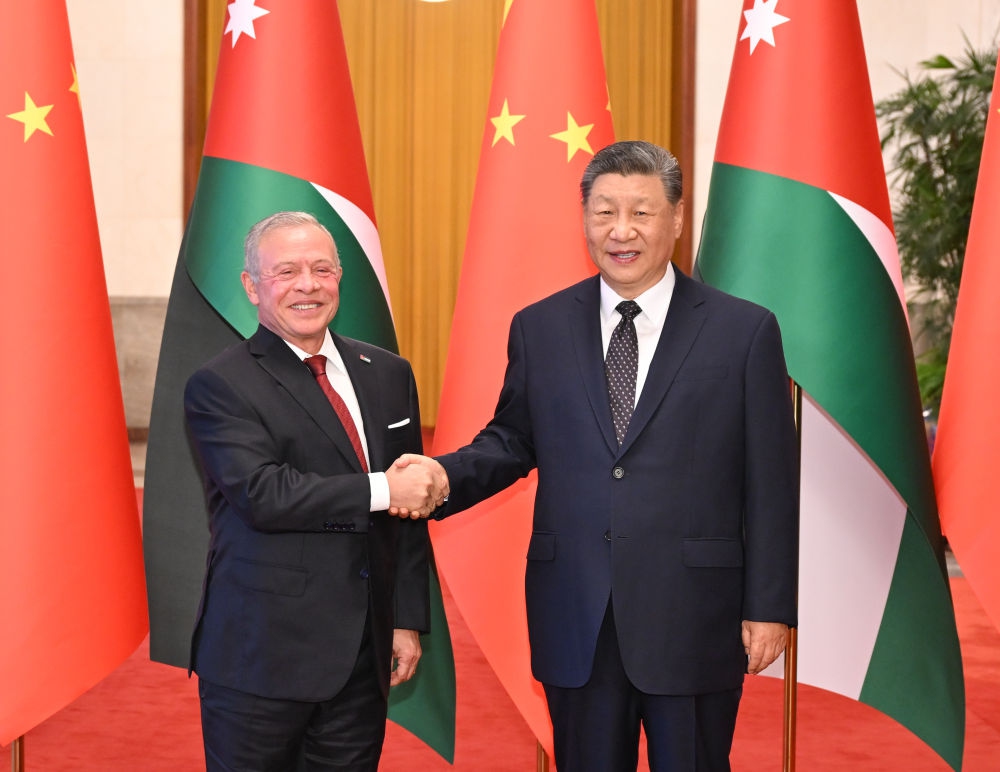
Photo: Xinhua
Chinese President Xi Jinping on Monday held talks with King of the Hashemite Kingdom of Jordan Abdullah II ibn Al Hussein in Beijing, calling on the two countries to further deepen the alignment of development strategies. The Chinese leader also exchanged views on the situation in the Middle East with the King who is on a state visit to China, which runs through August 18 to 24, the Xinhua News Agency reported.
The state visit marks King Abdullah II 's ninth visit to China since his accession to the throne, according to Chinese Foreign Ministry. It takes place more than a decade after the establishment of the strategic partnership between the two nations in 2015 and shortly before the 2027 commemoration of the 50th anniversary of diplomatic relations.
Following the talks, the two heads of state jointly witnessed the signing of multiple cooperation documents in areas including diplomacy, economy and trade, industrial and supply chains, and judicial affairs, Xinhua said.
The two sides issued a joint statement on deepening the strategic partnership between the two countries, per Xinhua.
Upgrading tiesThe essence of China-Jordan cooperation is mutual benefit and win-win outcomes. China and Jordan should further deepen the alignment of development strategies, Xi said. Both sides should enhance cooperation in traditional fields including economy and trade, infrastructure construction, transportation and mining, expand new drivers of cooperation in digital economy, artificial intelligence and green energy, and comprehensively deepen exchanges in education, culture, science and technology, tourism and other areas, Xi noted, according to Xinhua.
Jordan firmly adheres to the one-China policy and recognizes that Taiwan is an integral part of China's territory, the King said, Xinhua reported.
The King also noted that Jordan attaches great importance to its relations with China and is committed to deepening cooperation and exchanges with China in areas including economy and trade, manufacturing, agriculture, science and technology, medicine, culture and education. Jordan welcomes more Chinese enterprises to invest in the country to achieve common development and prosperity, per Xinhua.
Before the top-level engagement in Beijing, King Abdullah II started his China visit in Shanghai and Shenzhen.
In Shanghai, the King visited AgiBot, one of China's leading robotics companies, on August 18, followed by discussions on August 19 with representatives from the Trip.com Group, a leading global travel service provider, about strengthening cooperation in tourism sector with China, according to the Jordan News Agency (Petra).
During his trip in Shenzhen on August 20, the King visited the T Capital Showcase for Advanced Air Mobility and Robotics in Shenzhen, featuring leading Chinese companies' innovations in robotics, air transport solutions, and logistics services, per a separate Petra report.
Wang Jin, an associate professor at the Institute of Middle Eastern Studies at Northwest University in Xi'an, told the Global Times that the King's special trips to Shanghai and Shenzhen to observe scientific‑technological innovation and advanced industries send a positive signal that China‑Jordan cooperation is expanding from traditional economic‑trade, energy and infrastructure collaboration toward scientific‑technological innovation and industrial upgrading.
It shows that China‑Jordan strategic partnership is evolving from cooperation in traditional sectors toward all‑round, high‑quality and sustainable collaboration, injecting fresh impetus into the future growth of bilateral ties, Wang added.
"China and Middle‑Eastern countries including Jordan enjoy highly aligned development strategies and prominent industrial complementarity. Solid cooperation in traditional sectors has laid a firm foundation for the quality improvement and upgrading of bilateral ties," Zhu Yongbiao, an expert on Middle East affairs at Lanzhou University, told the Global Times.
Per data from the Jordan Chamber of Commerce (JCC), in 2025 China became Jordan's largest trading partner, with bilateral trade exceeding $6.7 billion, representing growth of more than 25 percent. The cumulative value of Chinese direct investments implemented in Jordan between 2010 and 2025 exceeded $3.56 billion across 71 projects, according to the JCC, which noted that "these investments have made an important contribution to the Jordanian economy and have helped create thousands of employment opportunities."
In an opinion piece in the Ammon News, Jordanian scholar Mahmoud Gudra Anakrih said the relationship with China offers Jordan the possibility of diversifying its economic partnerships at a time when regional instability is making traditional sources of growth increasingly vulnerable.
In another opinion piece for the Jordan News, political commentator Nidal Al-Majali said the China-Jordan ties have extended beyond trade to political, economic and strategic cooperation. "Jordan can serve as a bridge between China and the Arab region, rather than merely being an importer of Chinese products," he said.
According to Li Xi, an expert from the Center for Jordanian Studies, School of Foreign Studies, Northwestern Polytechnical University, China boasts a complete industrial chain and advanced manufacturing capacity, enabling in‑depth integration of scientific‑technological innovation and industrial development. Meanwhile, Jordan sits at the core hub of the Arab world, with political stability and close ties with regional countries, including Iraq, Israel, Syria and Palestine, allowing it to enjoy unique geopolitical strengths.
Jordan's "bridge role" is not merely serving as a transit point for Chinese goods entering Arab markets. More importantly, it can act as a bond for trade, investment, industrial collaboration, people‑to‑people exchanges and regional communication, Li noted.
By utilizing Jordan's regional connectivity, China and Arab countries can further realize complementary strengths and win‑win outcomes, said the expert, "This will drive China‑Arab cooperation to expand beyond energy and infrastructure into broader areas including industrial upgrading and scientific‑technological innovation."
2026 marks the 70th anniversary of diplomatic relations between China and Arab countries, and China is expected to host the second China-Arab States Summit in 2026.
A shared strategic choiceFour principles should be followed to push for the resolution of the Palestinian question, which is at the heart of the Middle East issue, Xi stressed, Xinhua said.
First, a political settlement should be upheld. Second, the principle of "Palestinians governing Palestine" should be followed in advancing the governance of the West Bank and the post-war reconstruction of Gaza. Third, humanitarian principles must be upheld. Fourth, fairness and justice must be upheld, Xi said, per Xinhua.
"For Amman, deeper cooperation with Beijing therefore carries both an economic and diplomatic dimension: attracting Chinese capital and expertise while building support among major global powers for Jordan's position on regional security and the Palestinian issue," says The Arab Weekly.
Located in the geopolitically volatile Middle East, Jordan is directly affected by the Palestine-Israel conflict, the Syria crisis and other regional security challenges. Its intensified communication with China represents a pragmatic move to pursue steady development amid regional turbulence, Wang noted.
"The King's visit enables China and Jordan to bolster strategic communication and coordinate stances on regional flashpoints. It also empowers development cooperation to serve as a pillar of regional stability," Wang said, noting that "the visit carries dual significance: It consolidates bilateral strategic mutual trust and facilitates peace, development and cooperation across the Middle East."
Coinciding with King Abdullah II's state visit to China, Iranian Deputy Foreign Minister for Legal and International Affairs Kazem Gharibabadi and Kuwaiti Foreign Minister Sheikh Jarrah Jaber Al-Ahmad Al-Sabah visited China to hold talks with senior Chinese officials, amid a flurry of Middle‑Eastern diplomatic outreach to China.
Taylor Luck, a Middle East correspondent for The Christian Science Monitor, told the Al-Monitor that the significance of the king's visit "lies in its timing." He added that a weeklong visit by the King to China at the time of a deep regional crisis signals a recognition in Jordan that "over-reliance on America is not sustainable in the long term, and increasingly, not even in the short term."
"With no end in sight to the war in Iran and an unchecked Israeli policy across the region, the kingdom is hedging against future uncertainty and a less predictable White House," reads the Al-Monitor's report.
Wang said the recent spate of high‑level engagements between Middle‑Eastern countries and China demonstrates their growing readiness for China‑related cooperation. Amid shifting international dynamics, regional states value diversified cooperation and strategic autonomy more, and seek less reliance on a single external power.
China adheres to mutual respect, non‑interference in internal affairs and mutually beneficial cooperation. It supports Middle‑Eastern countries in pursuing development paths suited to their national conditions and has earned solid political credibility in the region, the expert added.
According to Zhu, the so‑called "Looking East" trend should not be viewed as a camp‑alignment move. Rather, it is a pragmatic choice by regional states in pursuit of development, stability and strategic autonomy. "It also shows that China's vision of peaceful development and win‑win cooperation resonates with regional aspiration and is gaining wider recognition," he noted.
。 8 月 25 日消息,据《商业内幕》今天(25 日)晚间报道,由于旧金山办公室的安保人员可能罢工,Anthropic 要求当地员工本周开始居家办公。代表这些安保人员的工会却表示,他们此前根本不知道本周存在罢工安排。一名知情人士透露,Anthropic 上周收到安保服务商 Allied Universal 的通知,称旗下员工可能举行罢工。出于预防考虑,Anthropic 随后要求员工周一和周二不要前往旧金山办公室。代表 Allied Universal 员工的服务业雇员国际工会(SEIU)表示,工会目前正与 Allied Universal 以及加州其他安保企业进行长期的劳资合同谈判,但并未举行罢工授权投票,也没有发出本周罢工的威胁。SEIU 在加州代表数千名安保人员,并从 4 月起持续就新合同展开谈判。工会目前要求提高薪资、改善医疗保障,并加强职业培训。

二 | Anthropic 拒绝就要求员工居家办公一事置评。过去几年,科技行业整体的安保投入持续上升。《华尔街日报》此前报道称,Anthropic 和 OpenAI 都曾遭遇多起针对员工的威胁。根据 Anthropic 的招聘信息,公司实行混合办公制度,通常要求员工至少有 25% 的工作时间在办公室完成。

三 | Anthropic 预计最早将在 8 月申请 IPO,并已于 6 月秘密提交 S-1 注册文件草案。

四 | 二级市场投资者目前已将 Anthropic 估值推高至 15 亿美元(注:现汇率约合 101.08 亿元人民币)。

五 |
Current article:http://www.linlangdouwaqiexusan.bond/29ktzb/463s.xls
Published on:13:55:44


